
Build Once, Grow Often: How Content Pillars Turn Blogs Into ROI

Summary: In today’s AI-dominated search landscape, random posts won’t cut it. Content pillars offer a scalable, SEO-smart framework that transforms scattered blogs and social posts into a connected system built for visibility, trust, and growth. Businesses using structured strategies generate 67% more leads—and now, AI Overviews and generative search platforms reward pillar-style content that’s consistent and topical. In this guide, you’ll learn what content pillars are, why they matter more than ever, and how to build them step-by-step. Whether you're a team of one or leading a full department, this strategy gives you a clear, replicable path to results.
Here's What You'll Learn
- Why content pillars matter: Pillars align content with your business goals, making every post support lead generation, SEO, and ROI.
- Scalable framework for SMBs: Whether you're solo or scaling, 3–5 pillars offer focus without limiting creativity.
- Real-world success examples: From construction to herbal products, tailored pillars drive visibility, engagement, and conversions.
- AI-ready structure by design: Pillars naturally create consistent, topical clusters—exactly what AI Overviews favor when surfacing content.
- Time and cost savings: Reuse and repurpose pillar content across blogs, social, email, and video with minimal rework.
- Smarter planning, clearer impact: With content mapped to strategic themes, measuring results and proving value becomes easier.
Every blog post costs time and money—but without a strategy, that investment often goes to waste. Companies with structured content strategies and consistent blogs generate 67% more leads than those without. Why? Because strategic content connects the dots between awareness and action. Content pillars help you focus, reduce waste, and turn content into a business asset—especially in an era where AI surfaces concise, trustworthy answers directly in search results.
What Are Content Pillars And Why Are They Essential for Business Growth?
Content pillars are your go-to topics—the core themes your business wants to be known for. They act as a filter for every post you create, ensuring relevance and consistency. Most businesses use 3–5 pillars, tailored to their goals and audience needs.
Common pillar types include:
- Educational: Teach and inform.
- Promotional: Highlight offers or products.
- Inspirational: Motivate or shift mindsets.
- Engagement: Share stories, invite interaction.
Breaking Down the Buzzword
Without a framework, your posts can feel random and weaken your message. Content pillars fix this by aligning every piece with your business goals. Most companies use 3–5 pillars as the foundation—unique to their business but often based on themes such as promotional, educational, inspirational, or entertaining content. Here are a few examples across industries:
Construction Company Pillars:
- Project showcases
- Home improvement tips
- Testimonials and case studies
- Behind-the-scenes culture
Local Patisserie:
- Baking techniques and expertise
- Community involvement
- Seasonal specials and events
Herbal Remedies Brand:
- Product education
- Healthy lifestyle tips
- Customer testimonials
- Promotions and Q&As
These examples prove that no matter your industry, you can build pillar content that informs, connects, and sells. The keyword is focus. Posting at random dilutes your message and makes it harder to hit marketing goals. Content pillars keep you focused on a few strategic themes, so every post supports your business objectives.
How Content Pillars Help You Grow
By improving the effectiveness of your marketing strategies, content pillars contribute directly to the growth of your business:
🎯 More Leads, Less Guesswork:
Every piece of content connects back to your goals, making lead generation consistent—not luck.
⏱️ Time and Budget Savings:
No more starting from scratch. Pillars speed up planning and reduce waste by anchoring content to known topics.
🤝 Build Trust and Authority:
Consistent themes help your audience understand what you stand for—and build trust with search engines and AI tools too.
Before and After Content Pillars
Here’s what content marketing looks like before vs. after using content pillars:
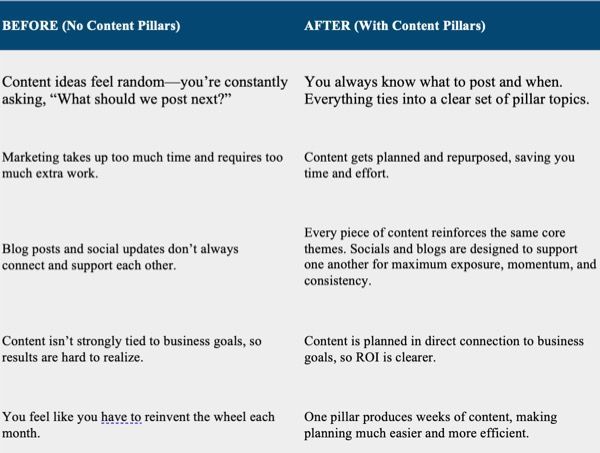
Want to see how content pillars could cut your marketing costs and boost ROI? Book a quick strategy call with WSI — we’ll map out how to put them to work in your business.
Building Your Pillars: A Step-by-Step Guide
As we break down the step-by-step process of building your content pillars, we will assume that you already know your target audience—your marketing personas, ideal customer, etc. That is the foundation of all your marketing strategies.
Step 1: Identify Your Core Business Objectives
Decide what you want your content to achieve. Be as specific as you can. Do you want to increase sales, sign-ups, or subscriptions; drive brand awareness; expand into new markets; or sharpen your competitive edge? It could be a combination of these. Whatever your core objectives are, pin them down from the start.
Step 2: Choose 3–5 Key Themes Your Audience Cares About
Select 3–5 themes that your audience is passionate about. These might be promotional, educational, inspirational, or entertaining—but tailor them to your specific business needs. For example, a herbal remedies company might use:
- Education: Herb spotlights and remedy how-tos
- Promotional: Monthly product focus articles
- Customer engagement: Testimonials, Expert Q&As
- Lifestyle tips: Expert advice on mindful living and holistic health
Step 3: Brainstorm Content Ideas Under Each Pillar
With your pillars in place, you and your team can now brainstorm content around each one. Start broad, then narrow. For example, list all the educational content you could post over six months, then trim it down to the ideas that support your goals. Do the same for all the other pillars.
Step 4: Reuse and Repurpose Across Channels
Content pillars apply everywhere—blogs, social, email, and video. Once defined, you can repurpose content across platforms and link it together for maximum impact.
Why It Matters in the AI Era
Search has changed—permanently. AI tools like Google’s AI Overviews, Bing Copilot, and ChatGPT now act as “answer engines,” pulling summaries and solutions directly into search results. Instead of ranking pages by keywords alone, these systems cite content that demonstrates topical depth, consistency, and trust—hallmarks of a strong content pillar strategy.
With 60%+ of searches ending in zero clicks, visibility today means more than traffic—it means being the cited source in AI-generated answers. Content pillars help position your site as an authoritative, easily understood resource that AI systems can lift, summarize, and link back to.
If your content is scattered or overly broad, it becomes harder for both AI and people to identify your expertise. But if your content follows a pillar framework, it sends clear signals about what your brand stands for, increasing your chances of being featured in AI summaries, voice responses, and multimodal search results.
Content Pillars Are Your AI-Era Advantage
In a world where attention is scarce and AI decides what gets seen, content pillars give your business structure, clarity, and leverage. They reduce content chaos, align every asset with your goals, and position your brand as a trusted source—both for customers and for AI. Whether you're looking to save time, cut content costs, or gain visibility in a changing search ecosystem, content pillars aren’t just a strategy—they’re your path to scalable ROI.
Turn every blog, email, and post into a growth engine. Book a call with a WSI Consultant and we’ll help you build content pillars that deliver long-term ROI.
FAQs
Q:What’s the difference between content topics and content pillars?
A: Topics are one-off ideas; content pillars are strategic themes. Pillars guide your long-term content plan, ensuring consistency, relevance, and alignment with business goals.
Q: How do content pillars impact AI search rankings?
A: AI Overviews and generative engines prefer content that’s topically consistent and authoritative. Pillars help structure your site around clear themes, making your content more likely to be cited.
Q: How often should I update or change my content pillars?
A: Reevaluate every 6–12 months or when your business goals shift. Pillars should evolve with your audience’s needs, but not change so often that they lose strategic value.
Q: Can I use the same content pillars for blogs, emails, and social media?
A: Absolutely. Content pillars are cross-channel by design. They help you repurpose efficiently while keeping messaging consistent across platforms.
Q: What tools can help manage content pillars?
A: Use content calendars (like Trello or Asana), pillar-to-topic mapping tools, and SEO platforms like Semrush or Clearscope to plan and measure pillar performance.
Q: Should small businesses use content pillars even if they don’t blog often?
A: Yes. Even minimal content performs better when it’s consistent and goal-aligned. Pillars streamline what to post and ensure your content supports growth.
Q: How do I know if my pillar strategy is working?
A: Track content performance by theme. Look for increased engagement, more qualified leads, and improved AI visibility (impressions, citations, assisted conversions).
About the Author
Part of the Marketing & Communications team at the WSI Home Office, Cecilia also heads up WSI’s Google Alliance Group.
The Best Digital Marketing Insight and Advice
Subscribe Blog
For information on our privacy practices and commitment to protecting your privacy, check out our Privacy Policy and Cookie Policy.
Don't stop the learning now!